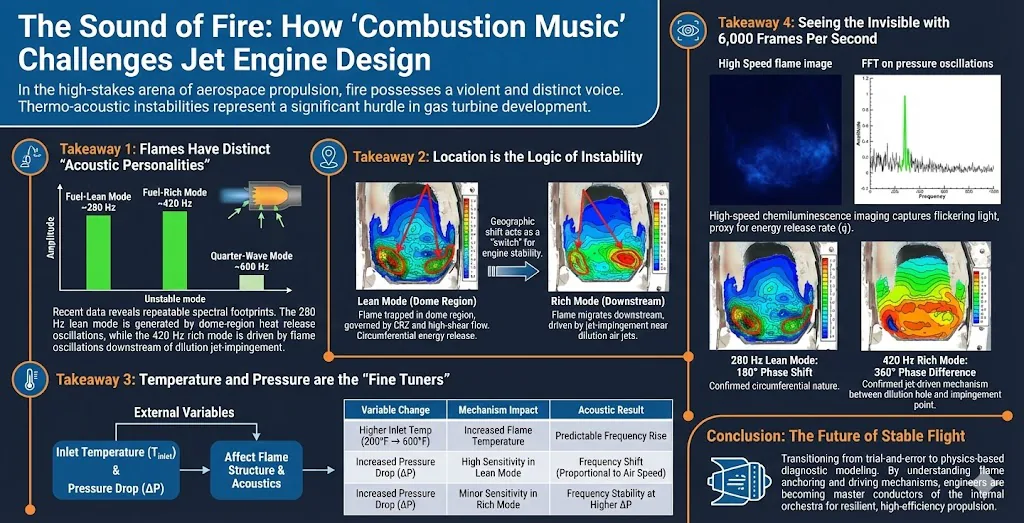
Thermo-acoustic instabilities represent a significant obstacle in the advancement of lean-premixed gas turbine technology. These phenomena are governed by the constructive coupling between unsteady heat release (q') and acoustic pressure oscillations (p'), as described by the Rayleigh Criterion.
When these fluctuations occur in phase, the acoustic field extracts energy from the combustion process, leading to high-amplitude pressure pulsations.
In modern swirl-stabilized systems, these instabilities are driven by:
Feed-coupling mechanisms: Equivalence ratio oscillations at the burner inlet.
Hydrodynamic instabilities: Vortex shedding and swirling flow periodicity.
Want this expertise on your problem?
The same rigor behind these analyses goes into every client engagement, from combustion test campaigns to hydrogen readiness studies.

 (opens the full-size image in a new tab)
 (opens the full-size image in a new tab)