Gas Turbine Emissions Mapping
De-mystifying complexity: the gas turbine mapping expert course.
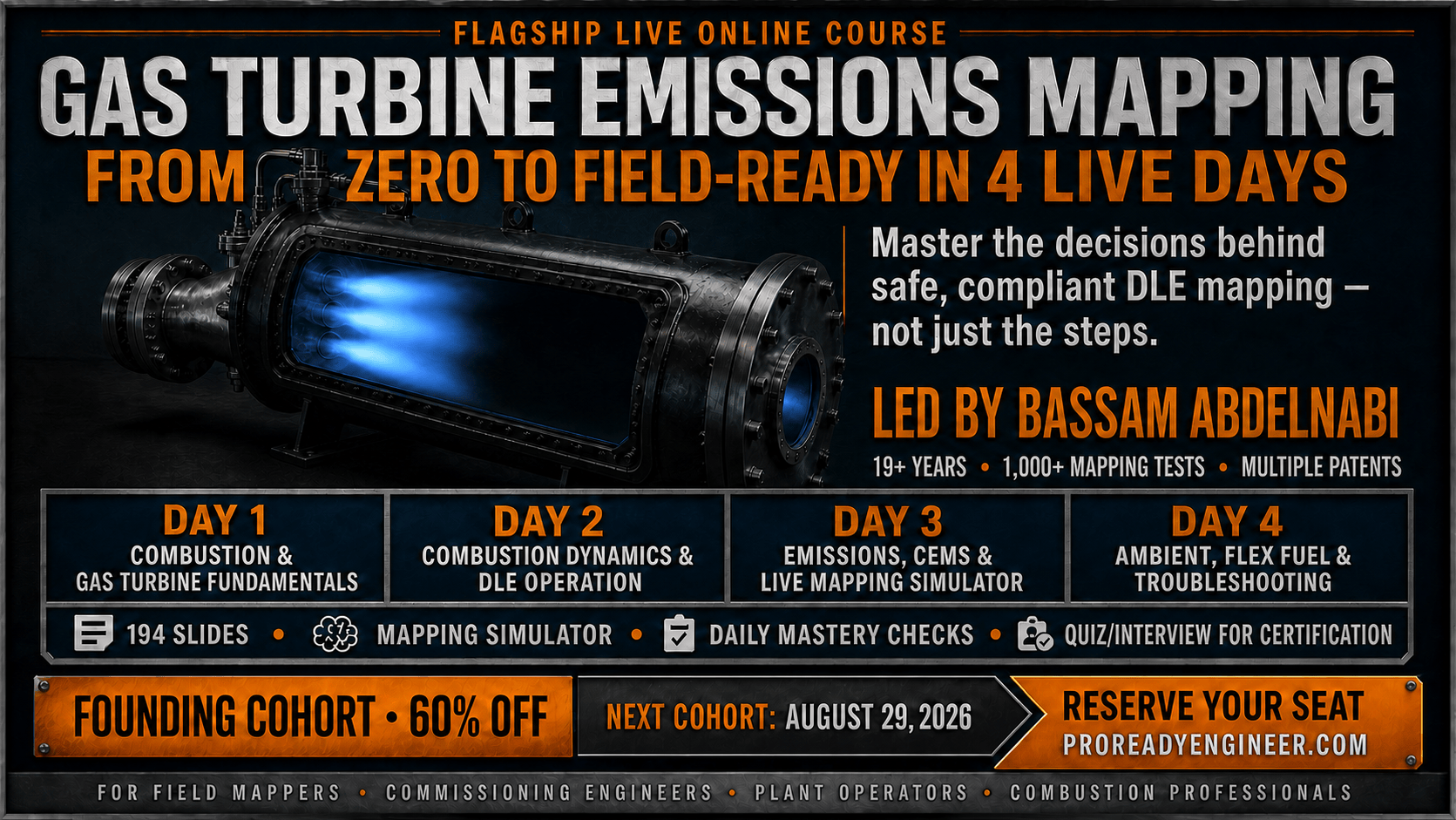
Modern DLE combustion systems look daunting: five distinct gas circuits, bounded by narrow dynamics corridors and moving ambient targets. This course takes you from zero gas-turbine knowledge to confident field mapper over four days, taught by a practitioner with 19+ years of live mapping experience and multiple patents in the field.
The 4-Day Arc
Combustion & Gas Turbine Fundamentals
The physics you need before you can tune anything: how flames behave, what sets flame temperature and NOx, and how a DLE machine is actually built, from premixer to metering valve.
- Premixed, diffusion and partially-premixed flames, and why DLE chose premixed
- Equivalence ratio φ, the lean operating window, and adiabatic flame temperature
- Thermal NOx (Zeldovich) and its exponential sensitivity to flame temperature
- Laminar flame speed compared: methane, heavier hydrocarbons, hydrogen
- Flashback, lean blowout and flame lift-off: mechanisms, precursors, protection
- Brayton cycle, gas turbine architectures, and DLE vs diffusion (SAC) philosophy
- Hardware: swirler, premixer, liner, transition piece, fuel nozzle
- Fuel supply chain: staging valves, metering valves and the float circuit
- Classify any flame and predict its temperature, NOx and stability signature
- Read a fuel-composition change and infer the flashback and NOx consequence
- Say what each valve and sensor does, and what happens in the combustor when it degrades
Combustion Dynamics & DLE Operation
Why premixed flames sing, what the amplitude limits actually oblige you to do, and how a combustion system is staged and controlled.
- Thermoacoustic instability and the Rayleigh criterion: when an oscillation grows
- LFD and HFD amplitude bands, and the action each band requires
- Protection hierarchy: E-ABAL → BRNUL → stage down → trip
- High-cycle fatigue: what dynamics does to hardware, and how fast
- Dynamic pressure sensors, sampling rate, signal processing and damping
- Combustion system fuel circuits, burner modes and mode-transition risks
- The key limiting tones: where each appears and the correct first action
- Fuel orifices: what they fix, how they are identified, when to swap
- Control schedules, operating-window boundaries and remapping triggers
- Decide from a described oscillation whether it will grow or decay
- Place a measured amplitude in the right band and take the right protective action
- Move pilot split, ELBO and TFlame the correct direction, and state the NOx cost
Emissions, CEMS & Combustion Mapping
Where NOx and CO come from, how they are legally measured, and then the mapping procedure itself, worked step by step on a simulated combustion system.
- NOx pathways (thermal, prompt, fuel-bound, N₂O); CO formation, quench and LBO proximity
- Extractive vs in-situ CEMS, and the EPA Method 7E sampling train
- Analyzers compared: CLD, NDIR and O₂ cells; probe siting and heated sample lines
- Calibration drift against the ±2.5%-of-span limit, and emissions data QA
- Regulatory corrections: 15% O₂, dry basis, ISO conditions
- Per-circuit emissions and acoustics response
- IGV settings versus load, and part-load CO
- Mapping preparation, safety protocols, tools, and the step-by-step procedure
- Cold-tune / hot-check discipline across fuel temperature
- Updating fuel circuits mapping tables, plus the remote tuning bias table
- Operating-line verification and mapping documentation requirements
- Correct raw analyzer readings to 15% O₂ dry, and judge a daily drift check
- Run a full mapping sequence on the simulated combustion system, inside the mapping window
- Produce as-left mapping tables and release an engine with the right evidence behind it
Ambient, Flex Fuel & Troubleshooting
What moves your map after you have set it (weather, fuel and failing instruments), and how to tell a real combustion event from a sensor lying to you.
- Inlet temperature, pressure, humidity and altitude effects on NOx, stability and output
- Ambient correction strategies and seasonal remapping
- Wobbe Index and Modified Wobbe Index: the ±3% alarm, ±5% action and ±10% trip bands
- Acoustic response to fuel-composition change, and measurement time delay
- Hydrogen blending: flame speed, flame position, convective delay and flashback risk
- Sensor failures (dynamic pressure, thermocouple and emissions) and their signatures
- Acoustic spikes, system freeze, wrong-circuit wiring, and calibration error propagation
- Root-cause analysis for LBO, flashback and stage-down events
- Field case studies: LBO during load rejection, and a commissioning wiring error
- Course review, operational best practices, and the common pitfalls to avoid
- State which way NOx, stability and power move for any ambient change
- Decide whether a fuel change needs a schedule correction, a remap, or hardware
- Separate a failing sensor from a genuine combustion event in unit data
Same hours every day
Five teaching hours with a 10-minute break between each, keeping focus high and fatigue low. Sessions stream live for all four time zones below.
Founding Cohort Pricing
For the first live offering, this advanced training is available at a special Founding Cohort price.
The Founding Cohort price is over 60% off the regular $4,500 per-seat rate. Register with no payment to hold your seat, then pay online or by invoice.
Your seat includes live instructor-led training, interactive mapping simulator access, course materials, and the opportunity to ask your questions directly during the live sessions.
This course is designed to help you understand the real logic behind gas turbine emissions mapping, including fuel splits, NOx, CO, combustion dynamics, safe operating windows, and practical mapping decisions.
This is not a lecture series. You build practical mapping understanding on a realistic simulator, with the instructor in the room to question and correct your decisions.
Interactive Mapping Simulator
Use a realistic simulator to see how mapping decisions affect fuel splits, NOx, CO, combustion dynamics, and safe operating windows.
Live Training with Bassam Abdelnabi
Learn directly from an instructor with deep real-world gas turbine combustion and mapping experience.
Direct Q&A During the Course
Ask your specific questions during the live sessions and connect the training concepts to real field situations.
Practical Mapping Examples
Work through examples that connect fuel splits, emissions behavior, dynamics, operability, and safe mapping decisions.
Course Materials You Keep Access To
All 194 slides across the four days, in your own browser account, so you can review any chapter long after the live sessions end.
Daily Evaluation and Mastery Check
Each day closes with a graded evaluation that teaches as it marks (every answer is explained), plus a mastery check built on scenarios you have not seen. 80% to pass, retakes allowed.
The Founding Cohort discount of over 60% is available only for the first live offering. Future offerings will return to the regular $4,500 per-seat price.
For teams enrolling multiple engineers, contact ProReadyEngineer for group registration options.
Bassam Abdelnabi
Founder of ProReadyEngineer. 19+ years in gas-turbine combustion with 1,000+ mapping tests across flex-fuel operations, from 100% propane to hydrogen blending. Multiple patents in gas-turbine combustion and emissions reduction. Bassam has trained and mentored dozens of engineers, helping them understand complex combustion and mapping concepts with practical, real-world clarity. See reviews in the Testimonials section on proreadyengineer.com.
The course is built around field-grade decisions, not textbook theory. Every section answers "what would you do at 2 a.m. when the operator calls" rather than "what does the textbook say."
- Field Mappers
- Commissioning Engineers
- Plant Operators
- Gas Turbine Experts
- Combustion Enthusiasts
No prior gas turbine knowledge required. You'll leave able to map similar systems end-to-end.
Reserve your seat for the September 5, 2026 cohort
Registration is open for this cohort.
Two credentials. One is included, the other is earned in front of the instructor.
Both are issued in your name, digitally signed, publicly verifiable by QR code or credential ID, and ready to add to your LinkedIn profile in one click. They differ in what they attest, and in who did the attesting.
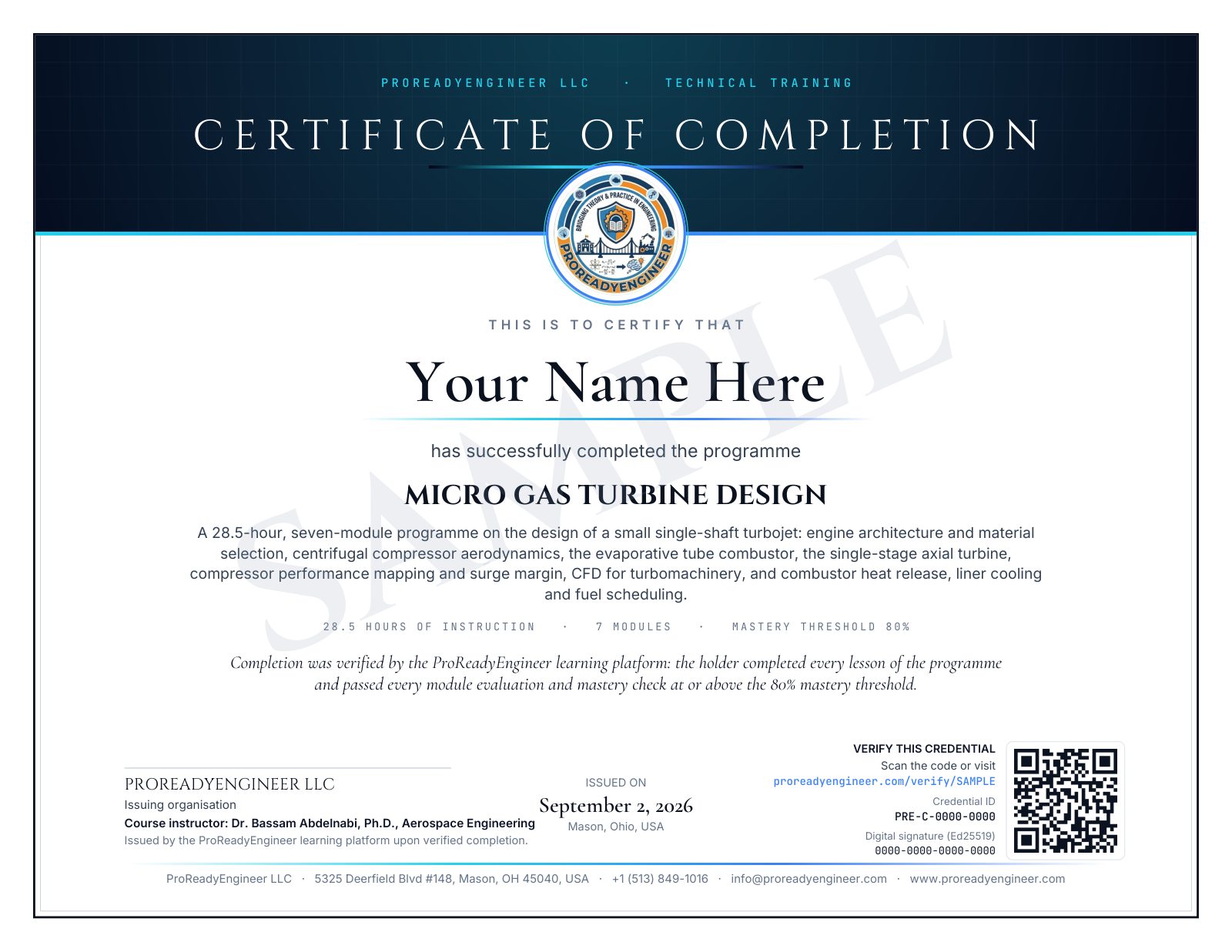
Certificate of Completion
IncludedIssued automatically, with no request and no wait, the moment you have completed every lesson and passed every module evaluation and mastery check at the 80% threshold. It states exactly that, so it means something.
- Generated and emailed the instant the last requirement is met
- Programme, hours and modules spelled out on the certificate
- Unique credential ID and QR code; anyone can verify it online
- Add to LinkedIn profile and share buttons built in
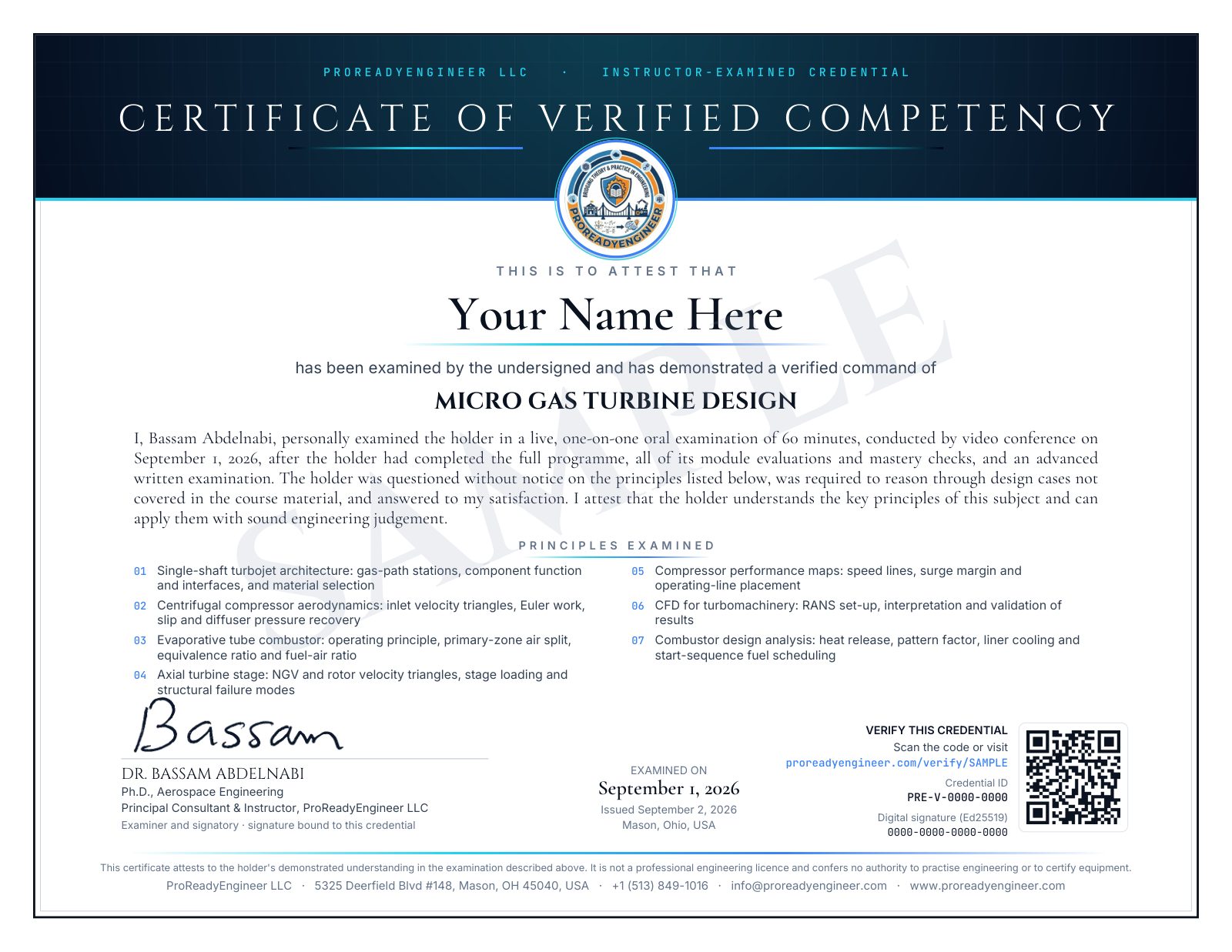
Certificate of Verified Competency
Instructor examined · $300The credential a hiring manager can trust. After the course, you sit an advanced written examination and then a 60-minute live, one-on-one oral examination with the instructor: questions without notice, design cases not covered in the material, reasoning out loud. A pass issues a certificate signed by the instructor, attesting that you were examined in person and demonstrated a verified command of every key principle of the subject, each one listed on the certificate.
- Prerequisite: the Certificate of Completion
- Advanced written examination at analysis level, 80% pass mark
- 60-minute oral examination by video, scheduled around your time zone
- Signed and issued only by the instructor after the examination
- One complimentary re-examination if mastery is not shown the first time
The examined tier is opened for each course once its first learners complete; ask us if you would like it for this course.
Every certificate is signed with a cryptographic key; the verification page checks the signature and the file hash, so an altered name or date is caught.
Scan the QR code or type the credential ID at proreadyengineer.com/verify to see the holder, the course and exactly what was attested.
"Add to profile" pre-fills the Licenses & Certifications form; "Share" posts the verification page, which shows the certificate itself.
Specimens above are marked SAMPLE and were not issued to anyone. Certificates attest to demonstrated understanding in the assessment described; they are not a professional engineering licence.
Independence notice: This independent ProReadyEngineer course is based on established public engineering and regulatory sources, original ProReadyEngineer teaching tools, and the instructor’s professional experience. It contains no OEM or other third-party confidential or proprietary information and is not affiliated with or endorsed by any OEM.