Micro Gas Turbine Design
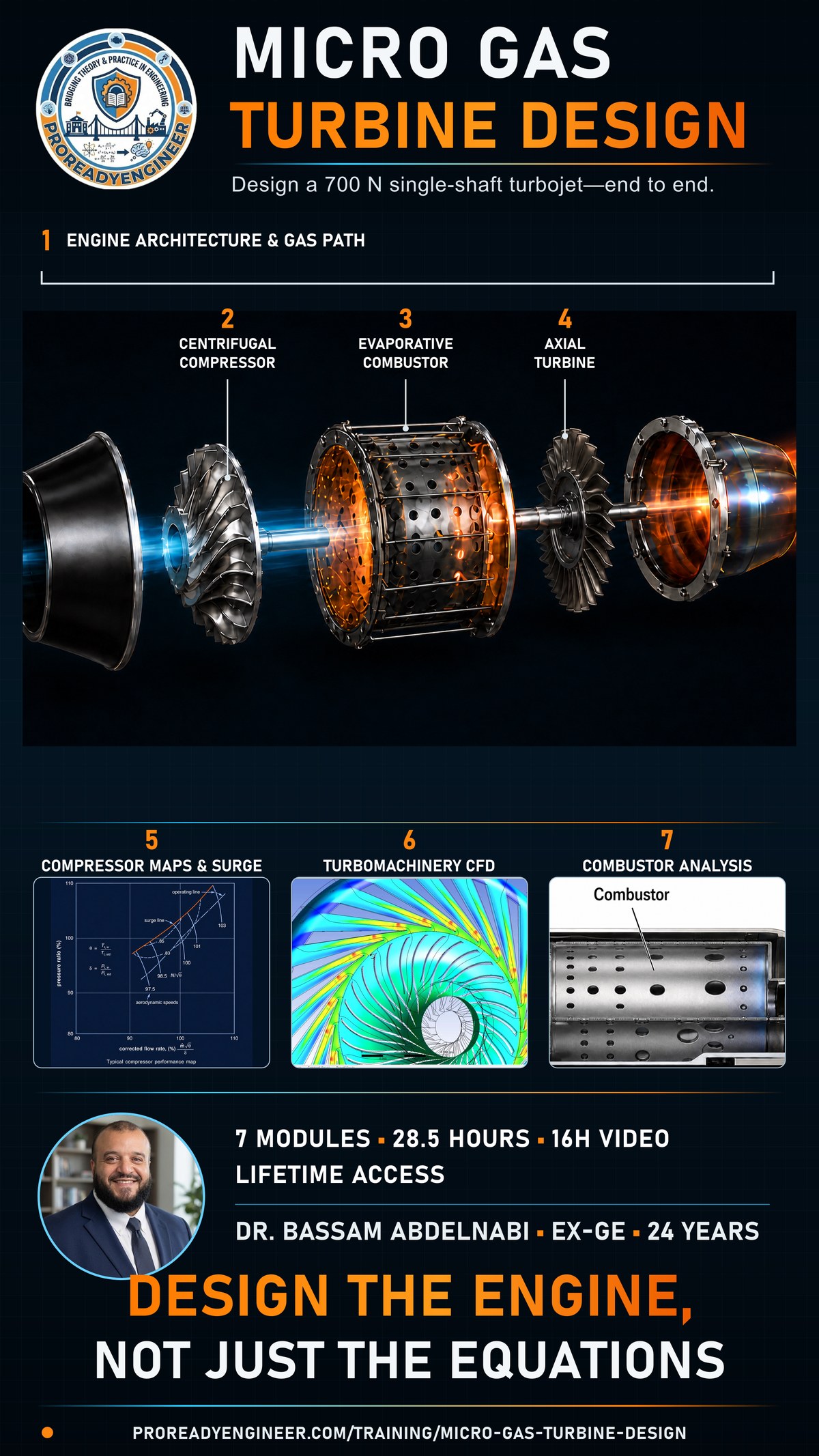
Design a 700 N single-shaft turbojet end to end, from gas path stations to CFD and combustor analysis.
Seven modules and 28.5 hours, recorded from the programme delivered to a national jet-engine development team. One 700 N class engine runs through every module, so the compressor you size in module two is the compressor the turbine has to match in module four.
- 7
- Modules
- 28.5
- Curriculum hours
- 16h
- Recorded video
- ∞
- Access
No subscription. No renewal. Yours for good.
Card or US bank account, securely through Stripe. Prefer Zelle or an invoice? Contact us.
- Lifetime access, including updates
- 16 hours of recorded sessions
- Decks, calculators and interactive tools
- Module quizzes and progress tracking
- Certificate with public verification
- 14-day refund, no forms
Not a survey course. A design capability.
Most turbomachinery material stops at the equations. This one carries a single engine from architecture to a stability check, and asks you to do the arithmetic at every step.
Size a compressor stage from a thrust target
Work from a 700 N spec to impeller diameter, tip speed, blade count and backsweep, then check the slip factor and the pressure ratio you actually get, not the one you hoped for.
Design the combustor and its fuel schedule
Air split across primary, secondary and dilution zones; evaporative tube sizing; heat release rate, pattern factor and liner cooling; and a start schedule that lights reliably.
Match a turbine to the compressor you designed
NGV and rotor meanline aerodynamics, blade loading, disc stress at speed and temperature, and the structural margin that decides whether the wheel survives.
Read a compressor map and defend an operating line
Corrected flow and speed, surge and choke, surge margin against the 10–20% target, and what actually happens to the operating point when the throttle moves.
Seven modules, 28.5 hours
Each module unlocks when you clear the one before it. Open any module below to see its objectives and full topic list.
Walks the complete gas path of a single-shaft turbojet station by station, from ambient through the inlet, centrifugal compressor, evaporative tube combustor, axial turbine and converging nozzle. Every component is covered for function, interface and failure mode alongside the material behind it: Ti-6Al-4V impellers, IN713 turbine parts, Hastelloy X liners and Si3N4 ceramic bearings. Closes with the manufacturing route for each part plus the shaft, casings, ECU and fuel system that tie the engine together.
By the end you can
- Identify every component in a single-shaft turbojet
- Understand its function and interface
- Explain the material selection rationale for each
Included with this module
- Slide deck
Topics covered
- Gas path station numbering convention (0-1-2-3-4-5-8)
- Inlet design considerations
- Centrifugal compressor: impeller, diffuser, volute
- Evaporative tube combustor: working principle
- Axial turbine: NGV and rotor
- Converging nozzle
- Main shaft, bearings, and casings
- ECU and fuel system overview
- Material selection: Ti-6Al-4V, IN713, Hastelloy X, Si3N4 ceramics
- Manufacturing process overview per component
Builds centrifugal compressor aerodynamics from the inlet velocity triangle through the Euler work equation, tip speed and pressure ratio scaling, slip factor by the Wiesner correlation, and vaned versus vaneless diffuser pressure recovery. The second half moves onto the performance map: corrected axes, speed lines, surge and choke, and where the operating line and surge margin sit between them. Worked examples run on the reference 80 mm impeller at 80,000 RPM delivering a pressure ratio of 3.5.
By the end you can
- Understand centrifugal compressor aerodynamics from inlet velocity triangles through to diffuser exit
- Read and interpret a compressor performance map
Included with this module
- Slide deck
- Design calculator
Topics covered
- Centrifugal compressor stage overview
- Inlet velocity triangle: absolute and relative velocities
- Euler turbomachinery equation: work input
- Impeller tip speed and pressure ratio relationship
- Slip factor: Wiesner correlation
- Vaneless and vaned diffuser comparison
- Pressure recovery and diffuser efficiency
- Compressor map: pressure ratio vs mass flow
- Surge line, choke line, and operating line
- Stall inception mechanisms
- Design point and off-design behaviour
Covers the evaporative tube combustor: how fuel vaporises inside heated tubes, why that approach beats a pressure-jet atomiser at small engine scale, and how the primary, secondary and dilution zones split the incoming air. Participants calculate fuel-air ratio and equivalence ratio for the primary zone against the Jet-A1 stoichiometric FAR of 0.0667, and set the combustor pressure drop budget. Ends with fuel manifold and tube arrangement, spark and glow plug ignition, and hot start causes and diagnosis.
By the end you can
- Understand the operating principle of an evaporative tube combustor
- Calculate air split, equivalence ratio, and fuel-air ratio for the primary zone
Included with this module
- Slide deck
- Design calculator
Topics covered
- Evaporative vs pressure-jet atomiser comparison
- Fuel vaporisation mechanism in heated tubes
- Primary zone stoichiometry: equivalence ratio calculation
- Secondary zone: CO burnout and dilution
- Dilution zone: pattern factor and TET shaping
- Stoichiometric FAR for Jet-A1 = 0.0667
- Primary zone FAR target: φ ≈ 1.0
- Fuel manifold and tube arrangement
- Combustor pressure drop: total and cold
- Ignition system: spark plug and glow plug types
- Hot start causes and diagnosis
Takes the single-stage axial turbine from NGV and rotor aerodynamics through velocity triangles, degree of reaction, stage loading and flow coefficient, and Euler work for zero exit swirl. The structural half covers disc centrifugal stress with the Lamé equations, the SF >= 1.5 requirement on rotating parts, LCF life by the Coffin-Manson approach and HCF screening on a Campbell diagram. Material limits are anchored to IN713 at 950 C turbine inlet temperature.
By the end you can
- Understand axial turbine stage aerodynamics
- Draw NGV and rotor velocity triangles
- Calculate stage loading and identify structural failure modes
Included with this module
- Slide deck
- Design calculator
- Interactive lab
Topics covered
- NGV and rotor function: nozzle and blade row aerodynamics
- Velocity triangle at rotor inlet and exit
- Degree of reaction: 50% reaction design
- Stage loading coefficient ψ = ΔCw/U
- Flow coefficient φ = Ca/U
- Euler work for zero exit swirl: W = U × Cw1
- Blade profile types: impulse vs reaction
- Turbine disc centrifugal stress: Lamé equations
- Safety factor requirement: SF ≥ 1.5 for rotating parts
- LCF life: Coffin-Manson approach
- HCF: Campbell diagram for blades
- Material temperature limits: IN713 to 950°C TIT
Explains how a compressor map is generated on a test rig and how to read it: corrected pressure ratio and mass flow axes, speed lines, the surge line, and the distinction between rotating stall and full surge. The working skill is surge margin, SM = (PR_surge - PR_op)/PR_op, and the >= 10% requirement for small turbojets. Also covers how a TET change and inlet distortion move the operating and surge lines, what casing treatment buys, and why margin collapses during a throttle transient.
By the end you can
- Read and interpret a centrifugal compressor performance map
- Calculate surge margin
- Identify dangerous operating conditions
Included with this module
- Slide deck
Topics covered
- How compressor maps are generated: test rig methodology
- Map axes: pressure ratio vs corrected mass flow
- Speed lines: corrected speed definition
- Surge line: physical mechanism
- Stall line: rotating stall vs surge distinction
- Operating line construction from cycle model
- Surge margin definition: SM = (PR_surge - PR_op)/PR_op × 100%
- Required surge margin: ≥10% for small turbojets
- Effect of TET change on operating line
- Effect of inlet distortion on surge line
- Casing treatment: slot and groove types
- Throttle transient: why surge margin reduces during acceleration
Runs the CFD workflow for turbomachinery end to end: geometry, mesh type, boundary conditions, solver and post-processing. Covers y+ and near-wall resolution, choosing between k-epsilon and k-omega SST for compressors, periodic boundaries for blade passages, and frozen rotor versus mixing plane interfaces, then applies them to a compressor case with inlet total conditions and exit static pressure. Ends on validation against 1D meanline and test data, the errors that produce converged but wrong answers, and where ANSYS CFX, StarCCM+ and OpenFOAM fit.
By the end you can
- Understand the CFD process for turbomachinery flows
- Set up a RANS simulation correctly
- Interpret and validate results
Included with this module
- Slide deck
- Interactive simulator
Topics covered
- CFD workflow: geometry → mesh → BCs → solver → post-processing
- Mesh types for turbomachinery: structured, unstructured, hybrid
- y+ concept: wall distance and turbulence model requirements
- Turbulence models: k-ε vs k-ω SST: which to choose for compressors
- Periodic boundary conditions for blade passages
- Frozen rotor vs stage mixing plane interface
- Compressor simulation setup: inlet total conditions, exit static pressure
- Key outputs: total pressure ratio, isentropic efficiency, velocity vectors
- Validation: comparing CFD to 1D meanline and test data
- Common errors: poor mesh quality, wrong BCs, convergence without accuracy
- Introduction to ANSYS CFX, StarCCM+, and OpenFOAM for turbomachinery
The analytical follow-on to the combustor design session: heat release rate from FAR and mass flow, combustion efficiency, and pattern factor with its target below 0.15 and its direct effect on turbine blade life. Covers dilution hole sizing to shape the TET profile, liner cooling by film, convective and transpiration routes, material selection between Hastelloy X and Nimonic 75, and evaporative tube flow matching to 2%. Closes with start fuel scheduling from propane ignition to main fuel, and hot-start diagnosis from the EGT trace.
By the end you can
- Analyse combustor performance
- Calculate heat release rate, pattern factor
- Design a fuel schedule for the start sequence
Included with this module
- Slide deck
Topics covered
- Heat release rate calculation from FAR and mass flow
- Combustion efficiency definition and measurement
- Pattern factor: definition, measurement, target <0.15
- Effect of pattern factor on turbine blade life
- Dilution hole sizing to achieve target TET profile
- Liner cooling: film cooling, convective cooling, transpiration
- Liner material selection: Hastelloy X, Nimonic 75
- Evaporative tube flow matching: tolerance ≤ 2%
- Fuel scheduling during start: propane ignition → main fuel
- Fuel schedule design: flow vs time vs temperature
- Hot-start diagnosis: EGT spike causes and corrective action
- Combustor CFD for reacting flow: simplified overview
Finish with a design of your own
The closing exercise hands you a thrust target and asks for a stage: diameter, speed, blade angle and count, with the physics behind each choice and the failure mode you are most exposed to. It is marked against a published rubric.
Everything from the room, on your schedule
The recordings are the sessions as they were taught, including the questions asked and the tangents worth keeping.
16 hours of recorded sessions
83 lecture segments across five of the seven modules, delivered as taught: the derivations and the judgment calls, not a scripted read.
The complete slide decks
Every deck from the programme, viewable in the platform alongside the lecture it belongs to.
Four design calculators
The same progressive spreadsheets used in the sessions: compressor, then compressor plus combustor, then the full engine including the turbine.
Two interactive tools
A rotor training lab and a radial-compressor optimisation simulator you can run against your own numbers.
Module quizzes with real gates
Interactive assessments on five modules. Clear a module to open the next. That structure is what makes the material stick instead of washing over you.
Certificate on completion
Issued once every module gate and assessment is cleared, with a verification code anyone can check.
Taught by an engineer who has built and tested them
Bassam Abdelnabi spent nineteen years in gas turbine combustion and test engineering, including at GE, with patents and published research behind him. The material here is the programme he delivered to a national jet-engine development team: the same decks, the same worked examples, the same reference engine.
That matters most in the parts a textbook leaves out: which clearance actually works on a machined impeller, why a diffuser separates when the sizing rule said it would not, and what a test cell tells you that a simulation will not.
Two credentials. One is included, the other is earned in front of the instructor.
Both are issued in your name, digitally signed, publicly verifiable by QR code or credential ID, and ready to add to your LinkedIn profile in one click. They differ in what they attest, and in who did the attesting.

Certificate of Completion
IncludedIssued automatically, with no request and no wait, the moment you have completed every lesson and passed every module evaluation and mastery check at the 80% threshold. It states exactly that, so it means something.
- Generated and emailed the instant the last requirement is met
- Programme, hours and modules spelled out on the certificate
- Unique credential ID and QR code; anyone can verify it online
- Add to LinkedIn profile and share buttons built in

Certificate of Verified Competency
Instructor examined · $300The credential a hiring manager can trust. After the course, you sit an advanced written examination and then a 60-minute live, one-on-one oral examination with the instructor: questions without notice, design cases not covered in the material, reasoning out loud. A pass issues a certificate signed by the instructor, attesting that you were examined in person and demonstrated a verified command of every key principle of the subject, each one listed on the certificate.
- Prerequisite: the Certificate of Completion
- Advanced written examination at analysis level, 80% pass mark
- 60-minute oral examination by video, scheduled around your time zone
- Signed and issued only by the instructor after the examination
- One complimentary re-examination if mastery is not shown the first time
Every certificate is signed with a cryptographic key; the verification page checks the signature and the file hash, so an altered name or date is caught.
Scan the QR code or type the credential ID at proreadyengineer.com/verify to see the holder, the course and exactly what was attested.
"Add to profile" pre-fills the Licenses & Certifications form; "Share" posts the verification page, which shows the certificate itself.
Specimens above are marked SAMPLE and were not issued to anyone. Certificates attest to demonstrated understanding in the assessment described; they are not a professional engineering licence.
From purchase to first lesson in a minute
Buy
Pay by card or US bank account through Stripe. Prefer Zelle? Contact us for an invoice.
Check your email
A sign-in link lands within seconds. No password to invent or forget.
Work through it
Watch, read, calculate. Progress saves as you go, on any device.
Clear the gates
Pass each module assessment to unlock the next. Finish everything and your Certificate of Completion issues itself; go further with the instructor-examined credential.
Before you buy
How long do I have access?
For as long as the platform exists. This is a one-time purchase, not a subscription. There is no renewal date and nothing expires. You can come back to any module years later.
Can I download the videos?
No. Lectures stream inside the platform and are not downloadable, which is what lets us put this much unpublished engine-design material online at all. Slide decks and the design spreadsheets are yours to work in.
What background do I need?
Undergraduate thermodynamics and fluid mechanics. The course starts from engine architecture and station numbering, so you do not need prior turbomachinery experience, but you do need to be comfortable with a control volume and an energy balance.
Is this theory or practice?
Both, weighted toward practice. A 700 N class reference engine runs through every module, so each piece of theory lands on the same machine. The worked examples use real dimensions and real speeds.
Do I have to take the modules in order?
Yes. Each module unlocks when you clear the one before it. That is deliberate: the compressor work feeds the combustor, which feeds the turbine, and skipping ahead means solving for numbers you have not derived yet.
What if it is not for me?
Email within 14 days of purchase, tell us what missed, and we refund in full. No form to fill in.
Design the engine, not just the equations
28.5 hours, seven modules, one reference engine, and the certificate at the end. $1,000 once, and it stays yours.
Independence notice: This independent ProReadyEngineer course is based on established public engineering and regulatory sources, original ProReadyEngineer teaching tools, and the instructor’s professional experience. It contains no OEM or other third-party confidential or proprietary information and is not affiliated with or endorsed by any OEM.
Training a whole team?
Team licences and private cohorts of this programme are available, including sessions tailored to your engine class.